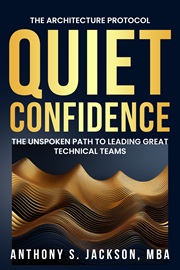
Chapter 1: The Accidental Manager
What actually happens in the first weeks of every technical leadership role, and why it's structural, not personal.
Written for technical leaders who were promoted before they were handed the foundation.
Anthony S. Jackson, MBA
Read this chapter if you were recently promoted, or have been a manager for a while but still feel like you're figuring it out in private.
Come back to it later if you've already made peace with the identity shift and have stopped measuring your worth by what you personally produce.
By the end, you'll have a reframe: why the discomfort you've been feeling isn't a character flaw or a warning sign, it's a normal response to a role that changes how others see you before it changes how you see yourself.
The conversation itself was shorter than Tom expected.
His director leaned back in the chair, smiled in that practiced way that signaled good news, and said, “We want you to step into the engineering manager role. You’ve earned it.”
The words landed cleanly, almost too cleanly, and Tom nodded before he had fully processed their meaning. He had imagined a longer buildup, a discussion of responsibilities, maybe even a warning about what would change, but instead the moment passed quickly, wrapped in phrases like leadership opportunity, natural next step, and the team already respects you.
On paper, it made sense. Tom knew the system better than anyone. He had solved the hardest problems, stayed late during fire-fighting drills, and quietly mentored others without being asked. This promotion felt less like a leap and more like recognition of what he had already been doing.
Yet as the conversation ended and his director stood to move on to the next meeting, Tom felt a subtle unease settle in, though he could not immediately name it. Nothing about his technical competence had changed, yet something else already had.
Tom had built his reputation on technical mastery: whether that meant writing code, designing systems, analyzing complex data, or architecting solutions others depended on.
By the end of the day, the announcement had spread through Slack, and congratulations started rolling in. Sarah sent a brief message that read, “Well deserved.” Dave responded with a thumbs-up emoji and nothing else. Lisa, their cross-functional partner, scheduled a meeting titled "Next Steps" that appeared on Tom’s calendar without explanation.
Each interaction was polite, supportive, and normal, yet together they carried a quiet signal Tom had not anticipated. He was no longer merely one of the team. He now represented something else, something closer to “the business,” even if no one had said it aloud.
That night, Tom replayed the promotion conversation in his head, searching for instructions that had never been given. There was no manual, no checklist, and no moment when anyone explained how to cross the invisible line between being a strong individual contributor and becoming a leader others would follow.
He realized, with a mix of relief and discomfort, that he had not pursued a management role, yet it had arrived anyway. It had happened gradually, almost predictably, the way it often did for technical managers.
Tom had not woken up one morning aiming to manage people. Like many technical managers, he arrived there after years of shipping, fixing, and caring, with little preparation for how different the responsibility would feel.
The promotion is framed as validation, but the experience that follows can feel disorienting, isolating, and quietly destabilizing.
Tom did not feel ungrateful, but he felt uncertain.
He wondered whether confidence was supposed to arrive with the title or whether everyone else simply hid the same doubts better. He worried that admitting uncertainty would undermine trust, yet pretending certainty felt dishonest and exhausting. The temptation to “fake it until you make it” surfaced almost immediately, not because Tom wanted to deceive anyone but because he wanted to protect the team from his own unease.
This is the trap many accidental managers fall into. They believe leadership requires certainty, authority, and immediate answers, so they suppress questions, overcompensate with action, or retreat into familiar technical work where competence feels safer. Over time, this erodes trust rather than building it because teams can tell when clarity is performed rather than created.
What Tom was beginning to sense, even without words for it, was that confidence did not require certainty. There was another path, one he did not yet fully understand.
It begins with acknowledging that the discomfort you feel is not a failure of character or capability. It is a normal response to a role that changes how others relate to you before it changes how you see yourself. Confidence does not arrive fully formed at the moment of promotion. It is built slowly through clarity, consistency, and the willingness to learn in public rather than to pretend in private.
Tom did not yet realize that the unease he felt after that promotion conversation was not a warning sign. It was an invitation to stop measuring his worth by what he personally produced and to start paying attention to the conditions he was creating for others. An invitation to replace the instinct to prove himself with the discipline to listen, reflect, and act deliberately. An invitation to become a different kind of leader, one who did not rely on volume, force, or certainty to be effective.
That invitation would not announce itself loudly. It would show up in subtle moments, strained meetings, uncomfortable silences, and in decisions that felt small but cast long shadows.
This is where the journey begins. Not with confidence, but with awareness.
From Individual Contributor to Chaos Coordinator
Tom felt the shift before he understood it.
One week, he was immersed in hands-on technical work, reviewing designs, refining systems, and experiencing the quiet satisfaction of solving hard technical problems. The next, his calendar was filled with roadmap conversations, stakeholder updates, performance discussions, and meetings he had not scheduled but was now expected to lead.
Nothing about his technical competence had diminished. But his work had changed overnight. He was no longer measured by what he personally built. He was now measured by what others accomplished and by how smoothly they accomplished it.
It was a leap so many technical leaders take, yet few are truly prepared for.
Tom had transitioned from churning out features to managing roadmaps. From architecting systems to navigating interpersonal conflict. From asking for criticism of his work to delivering feedback that could shape someone’s career.
And through it all, a quiet question lingered in the back of his mind:
Wait… am I supposed to just figure this out?
If you have ever found yourself Googling how to run a 1:1, wondering whether you are being too hard or too soft, or second-guessing how a comment might land, you are not alone.
Tom had done all three before the end of his first week.
The Shock of the Role Shift
The first real shock was not conflict. It was ambiguity.
Tom’s work changed immediately, but his sense of identity lagged. He still thought of himself as one of the engineers. In meetings, he caught himself saying “we” when referring to the team’s execution and “they” when referring to leadership decisions, even though he now occupied that space.
He was still the same problem solver. Except now the problems had feelings, opinions, and career goals. The success indicators were suddenly vague:
- Keep the team happy
- Ship faster
- Be a leader
Tom had always known how to tell whether he was doing well: the build passed, performance improved, the bug count dropped, and the architecture held up.
There were no visible markers for a difficult conversation handled well. No deploy notification for a boundary set clearly. No dashboard for trust.
When clarity disappeared, he defaulted to what had always worked before. He dove back into the technical details, more than necessary. He answered questions before they were fully formed. He stayed late to ensure delivery stayed on track. It felt productive.
It was also the beginning of the first crack. This is what no one prepares you for when you become a manager:
- Your work changes overnight, but your sense of self doesn’t, not yet
- You’re still the same problem-solver, with the exception that now those problems have feelings, opinions, and career goals
- The success indicators are ambiguous:
- “Keep the team happy.”
- “Ship faster.”
- “Be a leader.”
That’s when most new managers resort to what they’re most comfortable with: tackling technical work to gain credibility. That’s exactly where the first cracks start to show.
What No One Told You About the Promotion
Tom did not sign up to become an interpreter between business urgency and engineering reality. He signed up to build excellent systems.
He had built his value and identity on being a strong developer. He wrote clean, elegant code. He unblocked teammates. He understood tradeoffs deeply. He felt capable and in control.
Now he sat in meetings he had not scheduled, discussing deadlines he had not set, with stakeholders who did not care about technical elegance. He was expected to achieve outcomes through people rather than through technical contributions.
And no one told him that the strengths that made him exceptional as an individual contributor could quietly sabotage him as a leader.
His instinct was to fix.
His reflex was to answer.
His comfort zone was execution.
But leadership required restraint.
Letting Go of the Keyboard
During a team review, Sarah began explaining a technical tradeoff to a cross-functional partner. Halfway through her explanation, she hesitated.
Tom knew exactly what she was trying to say. He could have clarified it in twenty seconds, and he felt the pull to step in.
The silence stretched.
Every instinct he had, honed over years of engineering, told him to tighten the explanation and move the meeting forward. Instead, he paused.
Sarah gathered her thoughts, completed the explanation, and handled the follow-up questions herself. The stakeholder nodded. The discussion moved on.
Nothing dramatic happened. No applause. No visible breakthrough. But something subtle shifted.
Tom realized that if he had stepped in, the meeting would have moved faster, but Sarah would have moved backward. That was the first time he understood that leadership sometimes looks like restraint.
Letting go of the keyboard is not about abandoning competence. It is about choosing where your competence is most valuable.
The Hidden Cost of Staying the ‘Hero’
In your first few weeks, you jump in on the hard calls, smooth over the rough edges, and quietly make the problems disappear before anyone else notices. It feels good. Like leadership. Like value.
But here's what's actually happening beneath the surface:
- Your team can feel when you don't trust them with the hard stuff.
- They stop taking initiative, because you'll step in and handle it anyway.
- They bring you questions instead of answers, problems instead of solutions.
Without meaning to, you've become the bottleneck you were brought in to remove.
The Hidden Identity Crisis
What makes the transition so tricky isn’t just the new responsibilities. It’s the loss of your old ones.
You’re no longer the go-to person who saves the day. You’re not the fastest problem-solver in the room. You’re no longer the most brilliant architect. And without those markers of value, many new managers feel an unsettling question rise:
“Am I… still good at my job?”
This is the quiet crisis few talk about. You’re not failing.
You’re evolving. But no one gave you a map.
Side Note: I’m not suggesting that you don’t take on hands-on work. It’s important to keep your technical skills sharp. I’m only pointing out that, given your focus on management, you shouldn’t take on tasks on the critical path. If you need to step away from technical work to handle management priorities, it should not be crucial to your Team’s progress.
She Wasn’t “the Go-To Dev” Anymore
A few weeks into the role, Tom noticed something else he had not anticipated. Priya had always been the one people called in a crunch.
When production went down, her Slack lit up first. When a release was stuck, she jumped in and unblocked it. She loved being the go to developer, the one who could solve anything.
Tom had relied on her more times than he could count. So when she was promoted to manager of a neighboring team, she assumed she would keep doing what she had always done, only now with direct reports of her own.
But then it happened.
In a critical design review, one of her engineers presented a solution that Priya would’ve approached completely differently. The team debated.
Leadership nodded. They went with the engineer’s plan.
And no one even asked for her input.
Priya smiled politely, but inside? She felt a pang of panic: “Wait… am I not the expert anymore? What if they don’t need me? Who am I if I’m not the problem-solver?”
That was the moment she realized this role wasn’t about being the smartest developer in the room. It was about making the room smarter.
The identity crisis was real: letting go of what had always defined her value, while stepping into a new definition of leadership.
Tom began to see that being a strong technical leader was not about doing more. It was about doing things differently.
The first real skill was not delegation frameworks or perfectly structured 1:1s. It was adjusting to a quiet but painful realization: his value no longer rested on what he personally produced. It rested on what others did, and that shift stung.
- It meant laying down the technical safety blanket.
- It meant resisting the urge to prove worth through personal output.
- It meant measuring impact through growth, resilience, and team output rather than personal throughput.
No dashboard tracked that, and no automated check validated it. But it was the real work.
Tom eventually saw something uncomfortable. The very traits that had made him successful were now working against him.
He had always valued clarity. He liked knowing exactly what success looked like. He had thrived on control. Owning outcomes end-to-end gave him confidence. Competence had been his anchor. He was good at what he did.
Management disrupted all three:
- Success became murky.
- Control was distributed.
- Competence felt fragile again.
No one warns high performers about this part. The better you were at your craft, the more destabilizing it feels to step into a role where the scoreboard disappears and the feedback loop slows.
Far easier to jump back into solving the technical problem yourself than to coach someone through solving it. Far easier to take over than to guide. Far easier to control than to trust.
And that is precisely why so many strong technical contributors struggle in their first months of leadership. Not because they lack ability. Because they are learning to let go of the very things that once defined their excellence.
As Tom’s weeks unfolded, he began to understand something that had never appeared in the official job description. The role was not simply about managing work. It was about shaping energy.
He was no longer responsible only for tasks and timelines. He was responsible for how tension was processed. For how uncertainty was framed. For how setbacks were absorbed.
He found himself coaching without coding. Listening without immediately solving. Working through conflict without raising his voice. Making decisions with incomplete information.
He was not a:
- therapist
- project manager
- tech lead with more meetings
He was becoming something harder to define:
- The emotional thermostat of the team.
- The advocate upward.
- The translator sideways.
- The quiet force that steadied the room when ambiguity rose.
No one had said that explicitly. But it was unmistakably true.
This is where many capable leaders become load-bearing without realizing it.
They are steady enough to compensate for broken design. Competent enough to keep things moving. Trusted enough that decisions flow toward them by default. Mature enough to carry tension without creating drama. And because they can carry it, the system keeps giving them more.
That is not a reward. It is a structural warning.
Quiet Confidence helps a leader stop over-functioning internally. It helps them lead without panic, defensiveness, or constant self-doubt. It helps them become the kind of person a team can trust under pressure. That is necessary work. It may be the most necessary work.
Tom did not need to become someone else to lead well. He did not need to be louder, more political, or more performative. What he needed was intention. Clarity. Empathy. Calm assurance. The kind of confidence that does not announce itself but steadies a room when it matters most.
He was not there yet. But he could see the direction.
The Accidental Manager
You can now name what actually happened when you were promoted: not an expansion of the old role, but the start of a different one, where your value is measured by what others accomplish rather than what you personally produce.
The identity lag, where the title changes faster than the internal sense of legitimacy, is structural, not personal, and the temptation to prove worth through technical heroics is the first place it shows up.
Leadership begins not with certainty but with awareness: specifically, the awareness that restraint, not intervention, is often the more consequential act.
You stopped asking "Did I solve it?" and started asking the harder question, "Did I create the conditions for them to solve it?" Those two questions point in fundamentally different directions.
Delivered to your door. One-year guarantee.
Not ready yet? I write about technical leadership every weekday, one idea from inside the framework, nothing motivational, nothing generic.
You can unsubscribe at any time.
No spam. No sharing your information. If it stops being useful, you should leave.